
On February 22, 2013, the Reserve Bank of India issued guidelines on 'Licensing of New Banks in the Private Sector'.

Observing that there is liquidity overhand of Rs 13 lakh crore in the system, RBI Governor Shaktikanta Das said on Friday that the exceptional measures undertaken during pandemic will be dealt in sync with macroeconomic developments to preserve financial stability. Since the onset of the pandemic, the Reserve Bank has maintained ample surplus liquidity to support a speedy and durable economic recovery, he said while announcing the outcome of the Monetary Policy Committee (MPC) meeting. The level of surplus liquidity in the banking system increased further during September 2021, with absorption under fixed rate reverse repo, variable rate reverse repo (VRRR) of 14 days and fine-tuning operations under the liquidity adjustment facility (LAF) averaging Rs 9 lakh crore per day as against Rs 7 lakh crore during June to August 2021, he said.

New regime on loans to one party to kick in by Apr 2019.
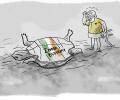
The International Monetary Fund (IMF) on Tuesday slashed India's growth forecast for 2022-23 (FY23) by 80 basis points to 7.4 per cent, citing less favourable external conditions and rapid policy tightening by the central bank. In its update to the April World Economic Outlook, the IMF said that though a global recession in 2022 was ruled out with a growth estimate of 3.2 per cent, the balance of risks was squarely to the downside, driven by a wide range of factors that could adversely affect the global economic performance. "The risk of recession is particularly prominent in 2023, when in several economies growth is expected to bottom out, household savings accumulated during the pandemic will have declined, and even small shocks could cause economies to stall.
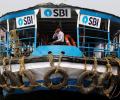
'No commercial bank will be allowed to fail. There is nothing to worry about.'

What connects P S Jayakumar of Bank of Baroda, V Vaidyanathan of Capital First Ltd and Chandra Shekhar Ghosh of Bandhan?

A weak economy coupled with rising Covid-19 cases and inflation that is above RBI's comfort zone, geopolitical developments, and upcoming India Inc's second quarter results for FY21 could impact sentiment, analysts say.

India is perceived to be a powerhouse for investment in coming times.

The size of the hole in today's banking crisis appears to be roughly 10 per cent of GDP.

Anup Roy and Krishna Kant on the challenges the public sector banks face in revitalising themselves
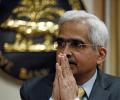
Economic activity has regained momentum from late-May after the dent caused by the second wave of COVID-19, and the pandemic's impact on the overall asset quality has been less than expected, Reserve Bank Governor Shaktikanta Das said on Thursday. However, Das flagged rising data breaches and cyber-attacks as among the risks for the recovering economy, along with others like firming global commodity prices. The governor also said the second wave had a "grievous toll" on the country.

With the reality of coalition politics staring the BJP in its face, this was inevitable, points out Ramesh Menon.
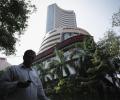
Offer size could vary from Rs 1,200 cr to Rs 2,000 cr
India's economy continues to be robust, but downside risks such as rising crude oil prices, adverse weather conditions, and the global banking crisis outweigh the upside potential in gross domestic product (GDP) growth in the current financial year (FY24), the finance ministry said on Tuesday in its Monthly Economic Review for March. "We reiterate that downside risks to our official forecast of 6.5 per cent for real GDP growth in FY24 dominate upside risks," the review said. "Opec's surprise production cut has seen oil prices rise in April, off their lows of low-seventies per barrel in March.

The newly-appointed chairman of State Bank of India (SBI) Dinesh Khara on Wednesday said maintaining quality loan book, safety of employees and customers will remain his top most priorities. Khara, who took charge on Wednesday, said the bank will continue to strive for even better customer experience.
.jpg)
Banking as we know it will stand on its head in the next 10 years.

Despite the national capital recording its best air quality on Diwali day in eight years, pollution levels may rise due to low night temperatures and sporadic burning of firecrackers though there is a ban on their manufacture, storage, sale and use within the city.

Economist Abheek Barua's insight into the global and domestic economy at the turn of the financial year.
The Reserve Bank of India (RBI) is precariously balancing two opposing objectives - maintaining easy financial condition in the domestic market, while ensuring external stability - and economists have started taking note. They say India is going through the classic trilemma of the 'Impossible Trinity'. The RBI cannot have an independent monetary policy (setting domestic interest rates) in an environment of an open capital account and flexible exchange rates. What is even more complicated for the central bank now is that financial market stability overlays all the other three objectives.

YES Bank, Bank of Baroda, SBI, IndusInd Bank, and RBL Bank are amongst the banks, Jefferies says, are most prune to "high risk" emanating from ADAG, Cox & Kings, CG Power, DHFL and Essar Shipping.
Initial public offering (IPO)-bound Life Insurance Corporation (LIC) of India's assets under management (AUM) increased to Rs 38 trillion as of September 2021, compared with Rs 37 trillion as of March 2021, said sources in the know. Its AUM is almost 3x the AUM of all the private life insurers in the country and over 15x more than the AUM of the second largest life insurer, SBI Life, as of September 2021. SBI Life's AUM was approximately Rs 2.4 trillion as of September 2021, said sources.

Policymakers should aspire to restore the pre-Independence environment where the rupee was trusted and used all over South Asia, in Southeast Asia, in West Asia, and in East Africa, suggests Ajay Shah.

Cleaning up India's grubby business climate is top of the agenda for both regulators and the government.

'You can put 25 per cent right now; put another 25 per cent when Nifty corrects another 500 points.' 'At 13,500 put another 25 per cent and at 13,000 one can get fully deployed.'

Eleven companies have launched their initial public offerings (IPOs) in December 2023, making this month the second-best December for public offerings since 1996. Collectively, they are raising Rs 8,182.7 crore this month. In December 2021, 11 companies raised Rs 9,534 crore. However, excluding December 2021, this month marks the best December for IPOs since 1996.

'Looking at the speed at which changes were made post the Franklin Templeton issue, we are awaiting more stricter norms in the months to come.'

'What's sad today is that there are so many people who cannot find work, not because the country is devoid of that opportunity, but because we are not doing enough in the country.'

UP's mills, dominated by the private sector's 94 units, have already expressed their inability to participate in the next crushing season

The consolidated entity can target good growth FY18 onwards, analysts say.

'Initially, Gift City was just another real estate project, but all that changed with Modi moving to New Delhi,' notes Tamal Bandyopadhyay.
The benchmark National Stock Exchange Nifty has rallied 4 per cent, or 750 points, from this month's low to end at 19,732 on week ending November 17. Technical analysts say the market could consolidate around the current levels as it is nearing the resistance zone. "The near-term uptrend status of the market remains intact, but there is a possibility of some more consolidation or minor weakness for the Nifty in the next one to two sessions.

It is high time the Indian government signalled discomfort with the UK providing refuge to those accused of financial crimes in India, states Jaimini Bhagwati.

'Modi wants to reverse everything Nehru did, but is shy of touching his daughter's most unwise policies.' 'There is no example of this more stark than bank nationalisation,' says Shekhar Gupta.

After last Monday's massive fall in the Indian markets, a lot of quality stocks have fallen significantly.

Government-owned Life Insurance Corporation of India (LIC) has seen substantial gains from its investments in Adani group shares, which have experienced a significant recovery over the past year. The value of LIC's stake in Adani group companies surged by 51.6 per cent, or Rs 22,591 crore, reaching Rs 66,388 crore as of Friday's close. This compares to Rs 43,797 crore on May 31 last year, according to stock exchange data.

Investor wealth on Wednesday diminished by Rs 1.84 lakh crore amid massive sell-off in the equity market.

Tata Group-owned AirAsia India, which is in the process of being merged with Air India Express, has taken short-term loans worth Rs 630 crore during the last six months to deal with cash crunch. AirAsia India has been making losses since its first commercial flight on June 12, 2014. Its net loss increased by 42 per cent to Rs 2,178 crore in FY22.

'There is no need to do anything, let your SIPs get deducted every month, and stick to your allocation between equity, fixed income and emergency funds and your risk covers.'

June was a memorable month for the 101-year-old Tamilnad Mercantile Bank (TMB). Last month, the Thoothukudi-based bank witnessed two new landmarks in a history in which the last three decades could easily qualify for a Kollywood blockbuster.

Given the impact Covid-19 pandemic had over the world economy, analysts expect global central banks, especially the US Fed, to keep the liquidity tap open, which, in turn, is likely to keep the equity markets, especially those in the emerging markets, buoyant.
